On August 8th, 2008, at precisely 8:08:08 PM, the Beijing Olympic Games began. This was not a coincidence. It was a deliberate application of Chinese numerology — a system in which numbers carry phonetic associations that shape how they are read culturally, and by extension, how millions of decisions get made.
This practice influences everything from wedding dates to phone numbers, apartment floors to business names. Understanding it helps explain choices that might otherwise seem arbitrary — and gives you a practical framework for navigating them.
What Makes Chinese Numerology Unique
Unlike Western numerology, which typically reduces numbers to a single digit through addition, the Chinese system is built on phonetics. Each number carries meaning because of how it sounds in Mandarin — specifically, which other words it resembles.
The number eight (八, bā) sounds like fā (发), meaning “to prosper.” This single acoustic overlap turned 8 into the most sought-after number in Chinese culture — coveted for addresses, phone numbers, license plates, and transaction amounts. The number four (四, sì) sounds like sǐ (死), meaning “death.” That one resemblance is enough to get the fourth floor removed from building directories across China.
The Meaning of Numbers 1 Through 9
Each number carries specific cultural weight. The Five Elements theory — rooted in the Hetu (河图) and Luoshu (洛书) diagrams from the I Ching tradition — provides additional structure: numbers map onto the five elements (木 wood, 火 fire, 土 earth, 金 metal, 水 water), with 1 and 6 associated with water, 2 and 7 with fire, 3 and 8 with wood, 4 and 9 with metal, and 5 and 10 with earth. This layering gives certain numbers additional resonance depending on context.
The Meanings of Key Numbers
- One (一, yī): Unity and new beginnings. On its own, it can carry a suggestion of solitude.
- Two (二, èr): Duality and harmony, reflecting yin and yang principles. Favored for partnerships and relationships.
- Three (三, sān): Associated with birth, life, and creativity. Connects to the Three Treasures of Taoism: compassion, moderation, and humility.
- Four (四, sì): Its sound directly echoes the word for “death.” Avoided consistently — buildings skip the fourth floor, phone numbers drop the digit entirely.
- Five (五, wǔ): Connects to the five elements theory (wood, fire, earth, metal, water) and the five blessings: longevity, wealth, health, virtue, and a natural death. Represents balance.
- Six (六, liù): Sounds like “flow” (流, liú). Implies smooth progress and easy forward movement. Considered strongly auspicious.
- Seven (七, qī): Historically linked to togetherness and the reunion of lovers — the Qixi Festival (七夕, Chinese Valentine’s Day) falls on the seventh day of the seventh lunar month. In everyday modern usage, however, 7 sits in a neutral middle ground: not avoided like 4, not sought after like 8. In certain regional dialects and social contexts — particularly around drinking culture — it can carry an edgier, more ambiguous energy, which is why you rarely see it pushed as an auspicious number the way 6 or 8 are.
- Eight (八, bā): The dominant prosperity number. Its resemblance to “prosper” (发, fā) makes it the most desired number across all categories — addresses, business names, event timing.
- Nine (九, jiǔ): Sounds like “long-lasting” (久, jiǔ). Historically tied to the Emperor as a symbol of enduring authority. Now used to signal longevity and completeness.
Number Combinations
Single numbers carry weight, but combinations function like short phrases — compressing a full sentiment into a string of digits.
- 1314 (一生一世, yī shēng yī shì): “One life, one world” — a declaration of eternal commitment. Common in romantic contexts.
- 520 (我爱你, wǒ ài nǐ): Phonetically close to “I love you” in Mandarin. Now a widely recognized digital shorthand for romantic expression.
- 888: Tripling the prosperity number is read as a major amplifier of financial good fortune.
- 168 (一路发, yī lù fā): “Prosperity all the way.” A common blessing for new ventures or journeys.

Using Numerology for Personal Decisions
The practical applications range from date selection to personal identifiers. People choose phone numbers, license plates, and business addresses based on these associations — actively seeking 8s and 6s, and paying premiums to avoid 4s.
Auspicious Dates
Selecting dates for weddings, business launches, or significant moves using auspicious dates numerology is standard practice. The goal is to align the timing with favorable phonetic energy rather than simply picking a convenient slot on the calendar.
Choosing the right elements for an important occasion goes beyond just numbers — even the symbolic meaning of flowers plays a role in setting the right tone.
Finding Your Kua Number
The Kua number — a concept from kua number feng shui — is derived from your birth year and gender. It identifies your most auspicious directions for health, success, love, and personal development.
To calculate your Kua number:
- Step 1 — Reduce your birth year: Take the last two digits and add them together. If the result is two digits, add again until you reach a single digit.
Example: 1985 → 8+5 = 13 → 1+3 = 4 - Step 2 — Male (born before 2000): Subtract from 10. → 10−4 = 6
Male (born 2000 or after): Subtract from 9. - Step 3 — Female (born before 2000): Add 5. → 4+5 = 9
Female (born 2000 or after): Add 6. If result is two digits, reduce again.
For quick reference, here are the Kua numbers for common birth years:
| Birth Year | Male Kua | Female Kua |
|---|---|---|
| 1970 | 9 | 6 |
| 1975 | 4 | 2 |
| 1980 | 8 | 7 |
| 1985 | 6 | 9 |
| 1990 | 1 | 5 |
| 1995 | 5 | 1 |
| 2000 | 5 | 6 |
| 2005 | 9 | 2 |
| 2010 | 4 | 7 |
Your Kua number identifies favorable directions for orienting your desk, bed, or entrance — aligning your physical space with positive qi flow. Name numerology based on character stroke counts offers a parallel method for deeper personal insight.
Feng Shui Numerology in Your Space
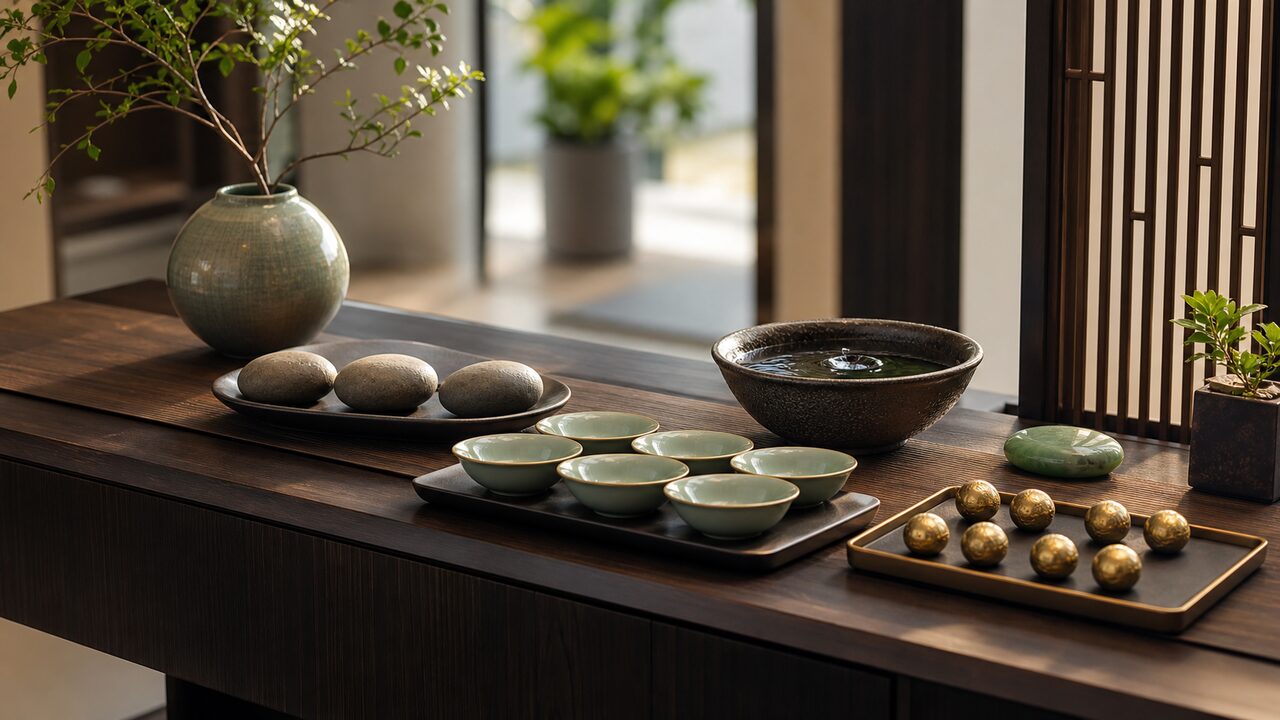
Feng Shui numerology applies these principles directly to home and office environments. The goal is to tune the flow of qi (vital energy) through intentional use of numbers in the space itself.
Numerical Applications
- Property addresses: An 8 or 6 in the address is a genuine selling point. A 4 makes properties harder to sell or rent — some developers skip the number entirely.
- Floor numbers: The fourth floor is frequently omitted from building directories. Floors with 8 or 9 are considered premium.
- Interior arrangements: The count of objects in a room — plants, candles, decorative items — can be chosen deliberately. Eight goldfish in an aquarium is a classic prosperity application.
Working Around Unlucky Numbers
- Strategic grouping: Arranging items in sets of 3, 6, or 8 reinforces positive associations.
- Elemental remedies: If a fixed number like a house address contains a 4, a practitioner may recommend specific colors or elemental objects — metal elements to neutralize the metal association of 4/9, or water elements to activate the 1/6 cluster — rather than avoidance.
- Symbolic objects: Art or decor referencing auspicious numbers can subtly shift the atmosphere without requiring structural changes.
If your address is number 44 — a combination practitioners consider doubly weighted — the standard elemental approach is to introduce metal-draining water energy at the entrance: a small water feature, a black or navy door mat, or deep blue accents near the threshold. The logic follows the Five Elements cycle: metal (4/9) generates water, so amplifying water draws energy away from the metal association rather than fighting it head-on.
Next time you choose a phone number, check a floor, or pick a date for something important — run it against this list first. The numbers around you are already communicating something. Start somewhere concrete: calculate your Kua number, then check which direction your desk currently faces. That single adjustment is where most people find the clearest, most immediate feedback.
Common Questions
Chinese numerology is an ancient belief system where numbers hold symbolic meanings and influence decisions in various aspects of life, such as choosing wedding dates or phone numbers.
The number eight sounds like the word for 'prosper' in Chinese, making it a powerful symbol of wealth and success, which is why it's highly sought after in addresses and business dealings.
The number four is considered inauspicious because it sounds like the word for 'death,' leading many to avoid it in contexts like building addresses and phone numbers.
People often consult auspicious numbers when making important decisions, such as selecting event dates or personal identifiers, to align with positive energies and enhance their chances of success.
Feng Shui incorporates numerical considerations to harmonize living and working environments, favoring auspicious numbers for property addresses and interior design to promote positive energy flow.