The Ming Dynasty theorist Yuan Hongdao spent years arguing that a single wild branch, placed with intention, could surpass an entire formal garden. His treatise Ping Shi (瓶史, History of Vases) remains the most precise articulation of what Chinese flower art actually is — and what it refuses to be. Understanding these traditions helps you choose a gift that resonates with the recipient’s heritage, rather than simply its surface color. You can learn more in our guide covering .
Ancient Roots
Flowers were never just objects in Chinese culture; they were the quietest way a civilization spoke to the heavens. This visual language has stayed consistent for centuries and forms the backbone of how we perceive the cultural significance of flowers today.
Historical Imagery
A stylized flower etched onto a pottery shard at the Palace Museum — its surface worn smooth by thousands of years — makes this connection feel immediate rather than academic. The simplest bloom carries the weight of an unbroken visual tradition stretching back to neolithic craft.
Spiritual Influence
The most lasting influence on flower art comes from two philosophical schools that shaped how practitioners saw a garden rather than simply what they grew in it.
Daoism champions the principle of Ziran (自然), or “naturalness” — not leaving nature untouched, but respecting its inherent character. Yuan Hongdao codified this in Ping Shi, arguing that the goal of flower art is to capture “wild interest” (野趣), not to impose rigid, artificial forms. In practice, a skilled arranger might:
- Preserve weathered deadwood to contrast with the freshness of new buds.
- Use an asymmetrical triangle to mimic how plants grow on a mountainside.
- Allow a branch to spill over the edge of a vase, breaking the formal boundary to create a sense of movement.
Chan (Zen) Buddhism introduced Wuchang (无常), the concept of impermanence. This taught artists to find beauty in every stage of a flower’s life — from bud to full bloom to graceful decay. The lotus symbolism in Chinese art embodies this most completely: the flower rises from mud, opens in full light, and eventually returns to the water, tracing a complete cycle of existence. For a broader look at individual bloom meanings, see our guide to Flower Symbolism A-Z: Meanings for Each Bloom.
The Poetry of Ink and Brush
A gallery of traditional Chinese flower painting rewards a slower kind of looking. The artist is not a recorder but a storyteller — and the story is rarely about likeness.
Beyond Likeness
In an old master’s bamboo painting, no leaf is actually perfect. Yet the spirit of the plant — its ability to bend without breaking — is present in every stroke. This is the heart of Xieyi, or “spirit-writing,” rooted in the aesthetic principle of Qìyùn shēngdòng (气韵生动): capturing vital energy rather than surface accuracy.
Brushwork and Character
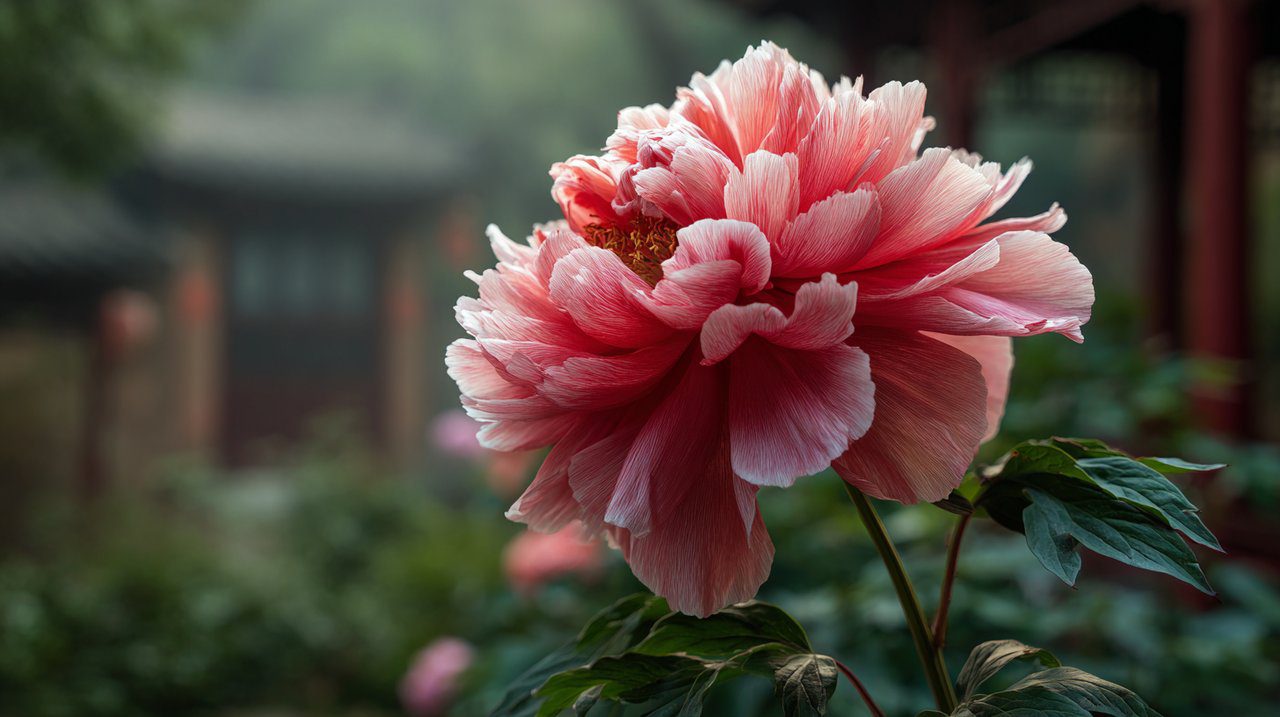
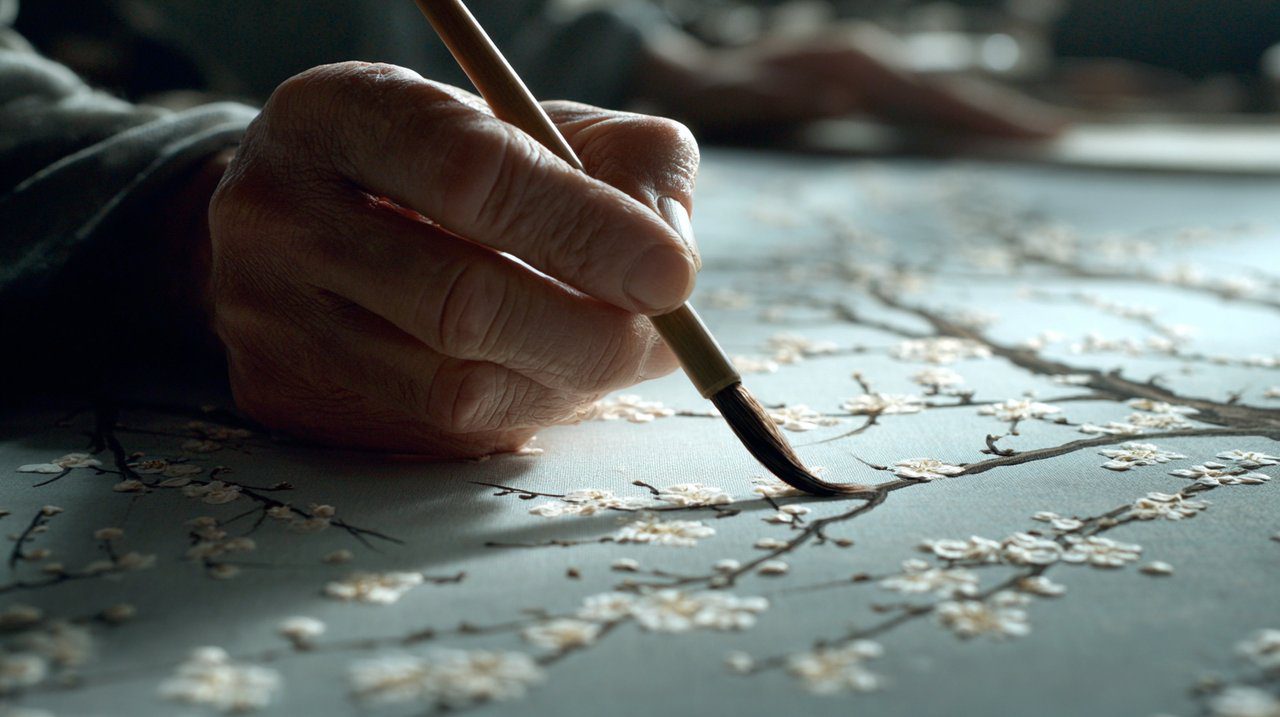
Every flower has its own rhythm, and a painter must move their hand accordingly. Peonies demand rich, wet ink washes to convey their weight. Plum blossoms are born from dry, jagged strokes applied to the bark. The treatment of the peony flower in Chinese art is perhaps the clearest demonstration of this technique — no other bloom requires the same quality of saturated restraint.
Clay and Fire
In handcrafted flower pottery, the fleeting beauty of a garden is given a body that outlasts centuries. The vessel is not passive — it is designed as a collaborator.
Eternal Beauty
The ancient concept of Zài Dào Yú Qì (载道于器) holds that a vessel should carry a way of life. The wide-shouldered Meiping bottle and the elegant, pear-shaped Yuhuchun vase are both designed to support the natural lean of a single branch, making the container as vital as the bloom it holds.
The Song Dynasty celadon produced at the Ru kiln (汝窑) — prized for its rain-grey glaze and almost imperceptible crackle — was considered a reflection of Confucian virtue: understated, precise, and entirely without vanity. The blue-and-white lotus on a Ming Dynasty vase tells a parallel story, its motif unchanged across generations while the gardens outside the workshop were replanted and forgotten.
Sculpture and Vitality
In jade or wood, flowers take on a three-dimensional life that feels almost startling. A master carver can render a rosebud soft enough that you instinctively reach for it. These carvings ask us to engage with nature through touch, not just sight — capturing the Qi, or life force, of a subject at its peak moment.
Life Cycles
The concept of Wuchang introduced by Chan Buddhism does not only appear in philosophy — it is felt most directly in the act of watching a flower age. Chinese flower art treats this not as loss but as completion.
Impermanence
A lotus observed through an afternoon — petals turning brown, curling inward — produces not sadness but a sense of order. The cherry blossom is loved precisely because its bloom is so brief, a reminder that the present moment is the only one we actually hold. This is Wuchang made visible: the cycle that Yuan Hongdao’s “wild interest” was always pointing toward.
Resilience
The bamboo teaches practitioners to yield so they don’t snap; the chrysanthemum models how to bloom when the season has turned against flowering. These are not metaphors for decoration — they are the observational foundation on which the entire philosophy was built.
Modern Connections
These traditions are still being practiced, not archived. Contemporary florists working in Shanghai and Beijing apply the same principles of negative space and asymmetrical tension that Yuan Hongdao described in the sixteenth century — now in response to a different kind of visual environment.
Living Arrangements
In a Jing’an apartment furnished entirely in white concrete and pale wood, a single branch of wintersweet (腊梅) placed off-center in a Longquan celadon vessel does precisely what a dense European bouquet cannot: it creates a pocket of stillness. The negative space around it is as deliberate as the branch itself. This is the Ziran principle applied to interior design — and it lands differently than a hundred roses ever could.
If you want to try this approach, start with a single-stem arrangement in an asymmetric vessel. Choose a bloom at an intermediate stage — not fully open, not in bud — and resist the impulse to fill the remaining space. The restraint is the point.
Common Questions
Flowers in Chinese Flower Art symbolize various concepts such as fertility, prosperity, and the cycles of nature. They serve as visual metaphors for human experiences and philosophical ideas.
Confucianism, Buddhism, and Daoism enrich flower imagery by imbuing specific blossoms with deeper meanings. For example, the plum blossom symbolizes resilience, while the lotus represents purity and enlightenment.
Traditional Chinese flower painting employs various brushwork techniques tailored to each flower's character, focusing on capturing the essence and spirit rather than just physical likeness.
Chinese Flower Art often depicts the life cycle of flowers, highlighting their beauty from bloom to decay, which serves as a reminder to appreciate the present moment and the transient nature of life.
Contemporary artists are reimagining traditional flower motifs using new materials and innovative techniques, blending classic themes with modern concepts, thereby keeping the art form relevant in today's world.