The number of roses in a bouquet carries its own message — sometimes a quieter one than the flowers themselves. In Chinese gifting culture especially, stem count is a deliberate choice: the right number turns a bouquet into a specific declaration, and the wrong one can read as awkward or even unlucky. Understanding these rose number meanings is essential for making the right impression.
This page is a direct reference. Use the table below as a quick index, then read on for why the most popular counts work the way they do.
Rose Number Meanings at a Glance
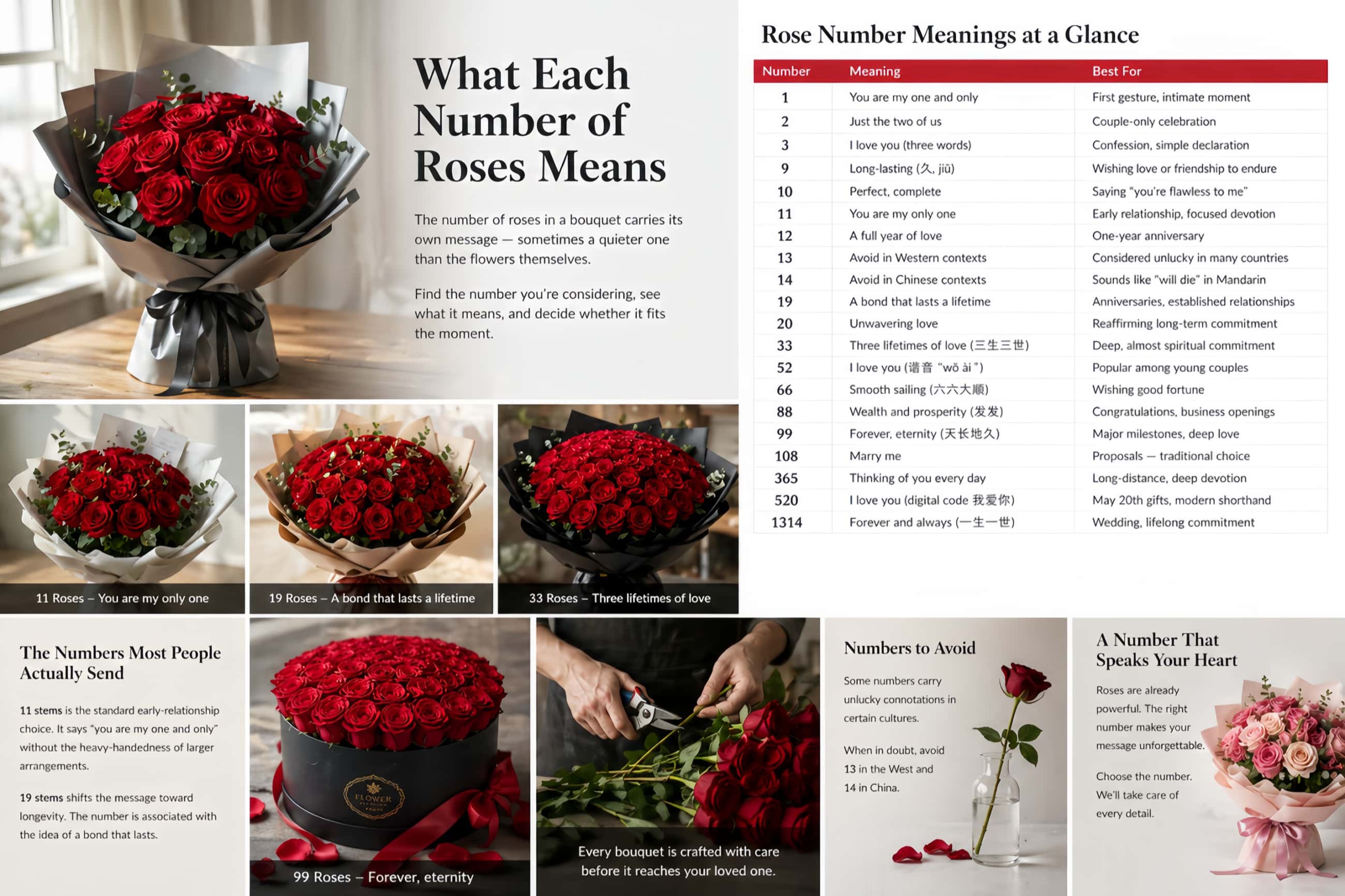
| Number | Meaning | Best For |
|---|---|---|
| 1 | You are my one and only | First gesture, intimate moment |
| 2 | Just the two of us | Couple-only celebration |
| 3 | I love you (three words) | Confession, simple declaration |
| 9 | Long-lasting (久, jiǔ) | Wishing love or friendship to endure |
| 10 | Perfect, complete | Saying “you’re flawless to me” |
| 11 | You are my only one | Early relationship, focused devotion |
| 12 | A full year of love | One-year anniversary, classic Western choice |
| 13 | Avoid in Western contexts | Considered unlucky in many countries |
| 14 | Avoid in Chinese contexts | Sounds like “will die” in Mandarin |
| 19 | A bond that lasts a lifetime | Anniversaries, established relationships |
| 20 | Unwavering love | Reaffirming long-term commitment |
| 33 | Three lifetimes of love (三生三世) | Deep, almost spiritual commitment |
| 52 | I love you (谐音 “wǒ ài”) | Romantic gesture, especially among younger Chinese couples |
| 66 | Smooth sailing, all goes well (六六大顺) | Wishing good fortune, business or personal |
| 88 | Wealth and prosperity (发发) | Congratulations, business openings |
| 99 | Forever, eternity (天长地久) | Major milestones, deep romantic statements |
| 108 | Marry me | Proposals — the traditional Chinese count |
| 365 | Thinking of you every day | Long-distance relationships, deep devotion |
| 520 | I love you (digital code 我爱你) | May 20th gifts, modern romantic shorthand |
| 1314 | Forever and always (一生一世) | Wedding, lifelong commitment |
Why People Choose These Numbers
The table gives you the definitions. What it can’t show is the social logic — why a particular count fits one moment and misfires in another. A handful of numbers carry the weight of most real-world rose orders in China, and these are the ones worth understanding properly.
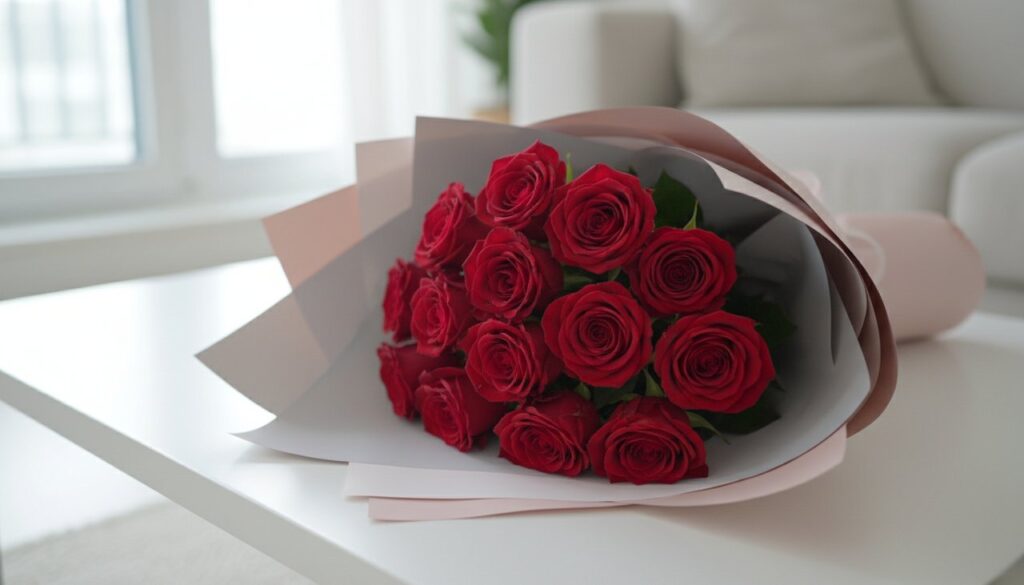
11 stems works because it calibrates intensity. Early in a relationship, an oversized arrangement creates pressure; a tiny one feels like an afterthought. Eleven declares exclusivity at exactly the volume a new relationship can absorb, which is why it has become the default for a first Valentine’s Day or an early anniversary.
19 stems is the count people reach for when the relationship has outgrown its beginnings. Sending it quietly marks a transition: this is no longer new, and I intend it to last. It suits anniversaries precisely because it speaks about time rather than passion.
33 stems borrows its weight from religion and, more recently, from television. The phrase 三生三世 (sān shēng sān shì) comes from Buddhist and Daoist ideas of past, present, and future incarnations, and the 2017 hit drama Three Lives, Three Worlds, Ten Miles of Peach Blossoms (三生三世十里桃花) turned it into pop-culture shorthand for fated love. For younger recipients, 33 roses now lands with both the old meaning and the new reference.
52 stems is a piece of wordplay. The Mandarin pronunciation (wǔ èr) echoes 吾爱 (wú ài), “my love,” making it the everyday cousin of the date-bound 520. Younger Chinese couples in particular enjoy this kind of layered homophone gifting, where the count itself is a small puzzle the recipient gets to solve.
99 stems works by amplification. If one 9 wishes the relationship long life, doubling it pushes the wish into 天长地久 — as enduring as heaven and earth. The sheer size also makes it a public statement, which is why it appears at major milestones, serious confessions, and meaningful apologies, where the scale of the gesture is part of the message.
108 stems is less a gift than a question. In Chinese romantic convention, presenting 108 roses is the unmistakable proposal signal, and recipients will read it that way whether or not a ring appears. If you are not proposing, choose a different number; 108 in any other context creates genuinely confusing signals.
520 stems belongs to a tradition the internet built. May 20th (5/20) has become an unofficial Chinese Valentine’s Day because the digits (wǔ èr líng) sound like 我爱你 (wǒ ài nǐ), “I love you.” A 520-stem arrangement on that date is a high-impact public declaration, and one that often ends up on social media.
Numbers to Avoid
A few numbers carry strong negative associations and should be skipped regardless of how the bouquet otherwise looks.
- 4 (四, sì) — Sounds like 死 (sǐ, “death”). Strictly avoided in any Chinese gifting context, including hospital visits and birthdays.
- 14 — The same logic compounds: 1-4 (yāo sì) can be read as 要死 (yào sǐ, “will die”). Avoid entirely for Chinese recipients.
- 13 — Carries no specific negative meaning in Chinese culture, but is broadly considered unlucky in Western contexts. If your recipient is Western or Western-influenced, choose 12 or 14 instead. (For overseas Chinese recipients raised in Western countries, the safer call is to avoid both 13 and 14.)
- 44 — Doubles the death homophone. Considered seriously inappropriate.
These taboos hold across mainland China, Hong Kong, and Taiwan, with small regional shadings. In Cantonese-speaking regions, 14 (sap6 sei3) sounds uncomfortably close to 實死, “certain death,” so the aversion runs even stronger in Hong Kong and Guangdong than in Mandarin contexts. The number 13, meanwhile, carries little stigma anywhere in the Chinese-speaking world, and in Hong Kong is occasionally read as auspicious. When in doubt, the 4-family numbers are the only hard rule; everything else depends on who is receiving.
None of these are arbitrary superstitions in modern usage; they’re live cultural reflexes. Florists in China will sometimes refuse to assemble bouquets in these counts even when explicitly asked.
Why Numbers Carry This Much Weight
Western floral traditions assign meaning primarily to species and color. Chinese floral tradition does the same. But it adds a third axis of meaning through stem count, rooted in the homophones built into the language itself.
This is why so many of the numbers above hinge on what they sound like rather than what they mathematically represent. 9 is meaningful because it sounds like “long-lasting.” 8 is meaningful because it sounds like “prosperity.” 520 is meaningful because the digits sound like “I love you.” The number isn’t a quantity; it’s a phrase. For those sending gifts from abroad, understanding the logic of Chinese number logic can transform a simple bouquet into a powerful message.
For overseas senders, this is the mechanism worth internalizing. If you’re choosing between two stem counts and they look equivalent on paper, the one that sounds like something good in Mandarin is almost always the right pick. Our guide to Chinese flower numerology goes deeper into the linguistic logic behind these counts.
Which Number to Send for Which Occasion
If you know the moment but not the number, this is the shortcut.
- First gesture or early relationship: 1, 3, or 11 stems. Avoid anything large — it reads as overwhelming rather than romantic.
- Birthday for a partner: 11, 19, or the recipient’s age in stems if it works numerically.
- Valentine’s Day: 11 (early stage), 99 (established couple), 520 (if sent on May 20th specifically).
- Anniversary: 19 stems for “lasting bond,” or the number matching the years together.
- Proposal: 108. This is the traditional count and recipients in China will read it as a marriage signal.
- Apology: 9 or 99 stems — both invoke “long-lasting” and reframe the gesture toward enduring commitment despite the misstep.
- Wedding gift: 1314 stems if budget allows; otherwise 99 with a note referencing 一生一世 works.
- Business congratulations: 66 or 88 — both invoke prosperity and avoid romantic reading. Skip Valentine’s-coded numbers entirely in professional contexts.
- Long-distance relationship: 365 stems is the maximalist gesture; 99 is the more practical equivalent.
Choosing and Sending
Once the number is settled, the rest is straightforward — color matches the message (red for declarations of love, pink for warmth, white for elegance or purity), and a clean modern wrap lets the count and the bloom do the work. When you send roses to China, you can browse arrangements at our roses collection, or go straight to red roses, pink roses, or white roses if the color is already decided.
Same-day delivery is available across major Chinese cities, including same-day Shanghai delivery, Beijing, and Guangzhou. Ordering is open around the clock, and orders placed before 18:00 local time can usually be delivered the same day. For date-sensitive numbers like 520 or a specific anniversary, the safest move is to order ahead and schedule the exact delivery date.
The right number, sent at the right moment, is the part of the gift that the recipient will read instinctively — even if no one ever explains it to them. Choose the count deliberately, and your message will be understood the moment the wrapping comes off.