A bouquet of white lilies in a hospital room might look like a kind gesture, but in a Chinese hospital it can cause real tension. Cultural taboos, strict hygiene policies, and practical delivery barriers all work against a well-meaning gift. This guide covers what to avoid, what works, and how to actually get flowers to a patient’s bedside when you send hospital flowers to China.

Why White Flowers Cause Problems
In Western culture, white lilies symbolize purity. In a Chinese hospital, they symbolize death. White is the color of mourning—it is what families wear at funerals. Placing white flowers next to a hospital bed forces a visual association no patient or family wants.
The lily has an additional layer of conflict. Its Chinese name (百合, bǎi hé) sounds identical to a traditional wedding blessing. So a white lily at a sickbed simultaneously evokes funerals and weddings—two occasions that have no place in a hospital room. This kind of symbolic collision is taken seriously, especially by older family members.
This is not a minor superstition. It directly affects the emotional state of the patient and everyone around them. Avoiding white flowers is the single most important rule when sending to a Chinese hospital.
What the ICU Will Not Allow

ICU wards ban flowers entirely, and the reason is clinical, not cultural. Potted plants carry soil-borne fungal spores—particularly Aspergillus—that are harmless to healthy people but potentially lethal to post-surgery or immunocompromised patients.
Cut flowers are not much better. Pollen and plant debris act as micro-dust that circulates through the ward’s ventilation system. In a space where every sensor and breathing tube matters, any airborne particle is a risk.
If the patient is in an ICU, do not attempt to send flowers at all. A fruit basket, a card, or a practical gift delivered to the family is the right move.
Numbers and Names That Matter
Gift-giving in China follows rules rooted in unlucky number rules. The most critical one: never send four of anything. Four (四, sì) sounds like the word for death (死, sǐ). An arrangement with four stems is not just unlucky—it is offensive in a hospital context.
Numbers like six and eight are preferred. Six sounds like “smooth” (顺利), and eight sounds like “prosper” (发). These associations may seem subtle, but Chinese families pay attention to them, especially during illness.
Flower names matter too. Carnations are a safe and widely appreciated choice—the Chinese name (康乃馨) contains the character for health (康). It is a small linguistic detail that adds real thoughtfulness to the gift. Sunflowers (向日葵) are another strong option: they face upward, suggest vitality, and carry no negative associations.
How Delivery Actually Works at Chinese Hospitals
This is the part most guides skip, and it is where things get complicated.
Most Chinese hospitals have a reception desk or security checkpoint at the entrance. Couriers—including flower delivery drivers—are often stopped here. They cannot walk into a ward the way they might in a Western hospital. The standard procedure varies by hospital, but it typically works like this:
- General wards: The delivery driver calls the patient or family member to come down to the lobby. If no one answers, the flowers are left at the reception desk or nurse’s station. Not every hospital has a reliable handoff process, so timing matters.
- Maternity wards: Usually more accessible than ICU but still restricted. Delivery is typically to the family member, not the patient directly. Flowers are generally allowed, but avoid strongly scented varieties—new mothers and newborns can be sensitive.
- ICU and isolation wards: No entry for outside deliveries. If you want to send something, coordinate with the family to receive it outside the restricted area.
The best approach is to confirm the patient’s visiting hours and schedule delivery during that window, so a family member is already at the hospital to receive the arrangement. Sending during off-hours increases the chance that flowers sit uncollected at a front desk for hours.
What to Send Instead
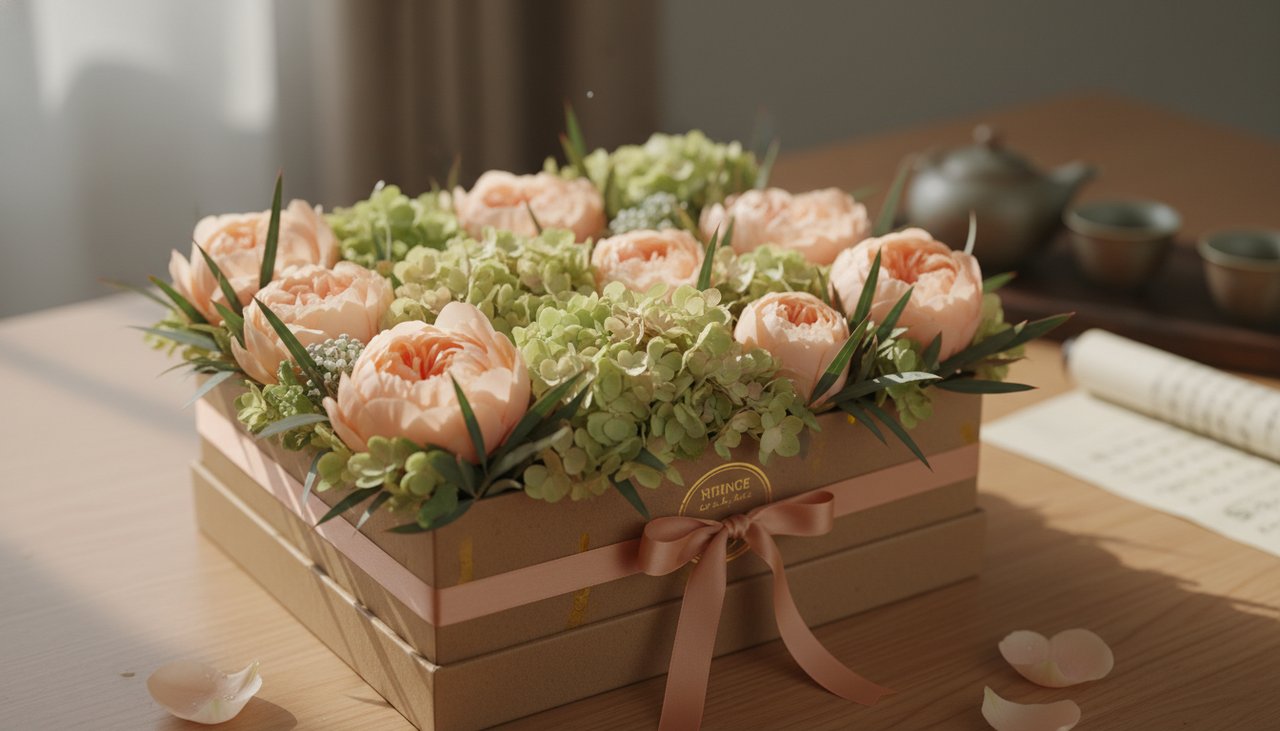
Hospital-safe arrangements use calming, low-saturation tones—soft peach, muted green, warm cream—instead of bright red (too festive for a hospital) or white (mourning). These muted palettes are becoming increasingly popular with modern Chinese florists because they look appropriate in a clinical setting without being depressing.
The format matters as much as the flowers. Self-contained flower boxes or baskets that require no maintenance are the best choice. A loose bouquet creates work: the family has to find a vase, change the water, clean up fallen petals. In a hospital, no one has time for that. Consulting an hospital-aware florist who specializes in hospital delivery helps you avoid these issues.
The highest form of respect in this context is a Chinese principle called 不扰为尊—do not create extra burden for an exhausted patient or their family.
Quick Checklist Before You Order
- Check the department: General wards usually allow flowers. ICU and isolation wards do not.
- Confirm visiting hours: Schedule delivery when a family member can receive it in person.
- No white flowers: This is non-negotiable in a Chinese hospital setting.
- Avoid the number four: In stems, in roses, in anything countable.
- Choose a box or basket: No loose bouquets that need vases and water changes.
- Skip strong scents: Especially for maternity wards or patients with respiratory conditions.
Sending flowers to a Chinese hospital takes more thought than a typical delivery. But when you get the details right—the color, the count, the timing, the format—the gesture carries real weight. It shows you understand not just the patient’s situation, but the cultural world they are recovering in.
Common Questions
While the gesture is appreciated, sending flowers to a Chinese hospital requires careful consideration of significant cultural taboos, strict hygiene policies, and logistical hurdles. It's crucial to understand these nuances to ensure your gift is well-received and doesn't cause unintended distress.
Absolutely avoid white flowers, as they symbolize death and mourning in Chinese culture. Bright red is also generally discouraged as it can appear too festive for a hospital environment. Opt for calming, low-saturation tones like soft peach, muted green, or warm cream instead.
Yes, avoid any arrangement featuring the number four, as its pronunciation in Chinese (sì) is similar to the word for death (sǐ). White lilies are particularly problematic, as their name (bǎi hé) can sound like a wedding blessing, creating an inappropriate symbolic collision in a hospital setting.
ICU wards strictly prohibit flowers due to clinical hygiene risks, such as fungal spores and airborne allergens. For maternity wards, flowers are generally allowed but strongly scented varieties should be avoided due to sensitivity in new mothers and newborns. Always confirm the specific ward's policy.
Unlike in many Western hospitals, couriers are often stopped at the main entrance or security checkpoint. They usually need to contact a patient or family member to collect the flowers from the lobby or reception area, as direct ward access is restricted. Scheduling delivery during visiting hours is highly recommended to ensure a smooth handover.
Opt for self-contained flower boxes or baskets that require no additional maintenance from the family. Carnations (symbolizing health) and sunflowers (vitality) are excellent choices. If flowers aren't suitable or permitted, a fruit basket, a thoughtful card, or a practical gift delivered to the family are much appreciated alternatives.
The guiding principle is '不扰为尊' (bù rǎo wéi zūn), which means 'do not create extra burden.' This emphasizes choosing gifts that are easy to receive, require no maintenance, and do not add stress to an exhausted patient or their family during a challenging time.